Modern medicine has made remarkable advances in imaging, surgery, and drug development. Yet one of the most powerful diagnostic tools available today remains surprisingly underutilised: DNA testing.
Around the globe, patients spend years moving from one doctor to another, undergoing repeated scans, biopsies, and laboratory investigations without receiving a clear explanation for their symptoms. In many of these cases, the answer is hidden within their DNA.
Genetic testing is often perceived as something relevant only for rare childhood disorders or inherited cancers. In reality, it can uncover the root cause of a wide range of seemingly unrelated medical problems — affecting adults and children alike.
More importantly, identifying the underlying genetic cause can sometimes lead to simple interventions that dramatically improve outcomes — or even save lives.
When the Cause Hides in Plain Sight
Consider a patient who develops liver cirrhosis despite never consuming alcohol and having no evidence of viral hepatitis. Traditionally, such cases may be labelled as "cryptogenic" liver disease — meaning the cause remains unknown. DNA testing can reveal inherited metabolic disorders that silently damage the liver over decades.
Three conditions illustrate this problem with particular clarity.
Hereditary Haemochromatosis — HFE gene · Iron overload
The body absorbs excessive iron, which gradually accumulates in the liver, heart, and pancreas — leading to cirrhosis, diabetes, and heart disease. Prevalence: 1 in 300 individuals of European ancestry. Treatment: regular therapeutic phlebotomy. When caught early, normal life expectancy is achievable.
Wilson Disease — ATP7B gene · Copper metabolism
Toxic copper accumulates in the liver and brain, causing liver failure, movement disorders, psychiatric symptoms, and cognitive decline. Once identified, copper-chelating medications can dramatically alter disease course. Patients who might otherwise face severe disability can often lead productive lives.
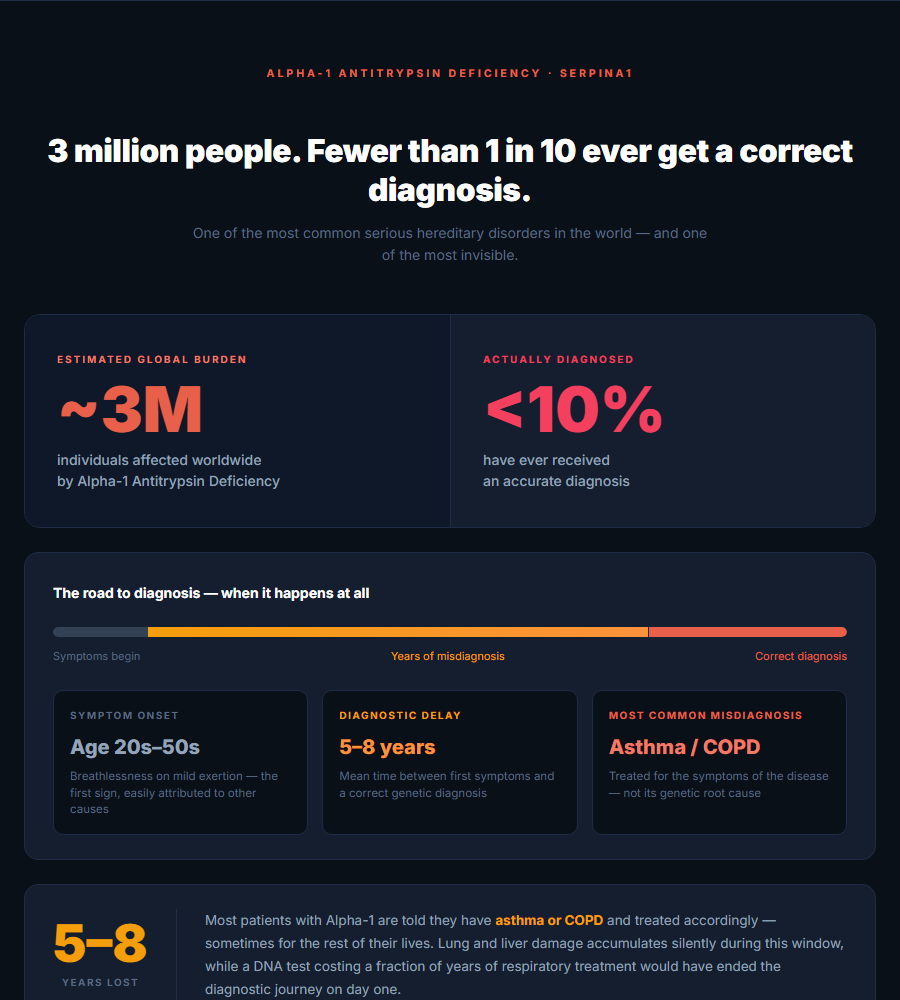
Alpha-1 Antitrypsin Deficiency deserves its own examination — because its numbers reveal not just a clinical problem, but a systemic failure of diagnosis.
Beyond the Liver: The Broader Case for DNA Testing
The value of DNA testing extends far beyond liver disease. Patients with recurrent pancreatitis, unexplained heart failure, sudden cardiac arrest in young individuals, severe cholesterol disorders, hearing loss, developmental delays, infertility, neurological conditions, and certain cancers may all benefit from identifying an underlying genetic cause.
Importantly, genetic testing does not merely provide a diagnosis — it provides answers. It transforms uncertainty into understanding.
What genetic testing offers
- Root cause identification — understand why disease occurs, not just what it looks like
- Family risk assessment — identify at-risk relatives before they develop symptoms
- Personalised treatment — guide therapy decisions based on the specific genetic variant
- Prevention before symptoms — in some cases, disease can be prevented before it ever manifests
The Economics of Not Testing
Genetic testing is often perceived as expensive. The cost of not identifying the root cause is frequently much higher.
Patients with undiagnosed conditions may spend years undergoing repeated consultations, imaging studies, laboratory investigations, hospital admissions, and invasive procedures in search of answers. A timely genetic diagnosis can shorten this diagnostic journey, prevent unnecessary testing, guide more effective treatments, and in some cases help avoid life-threatening complications that require costly interventions — intensive care, cancer treatment, or organ transplantation.
DNA testing should not be viewed simply as an expense. It is an investment in faster diagnosis, better outcomes, and more efficient healthcare.
A Different Kind of Medicine
Healthcare has traditionally focused on treating disease after it develops. DNA testing offers something fundamentally different: the ability to understand why disease occurs in the first place.
As genomic medicine becomes increasingly accessible, DNA testing is evolving from a specialised investigation into an essential component of preventive and precision healthcare.
The question is no longer whether genetic information is clinically useful. The question is how many missed diagnoses could be avoided if we used it more often.